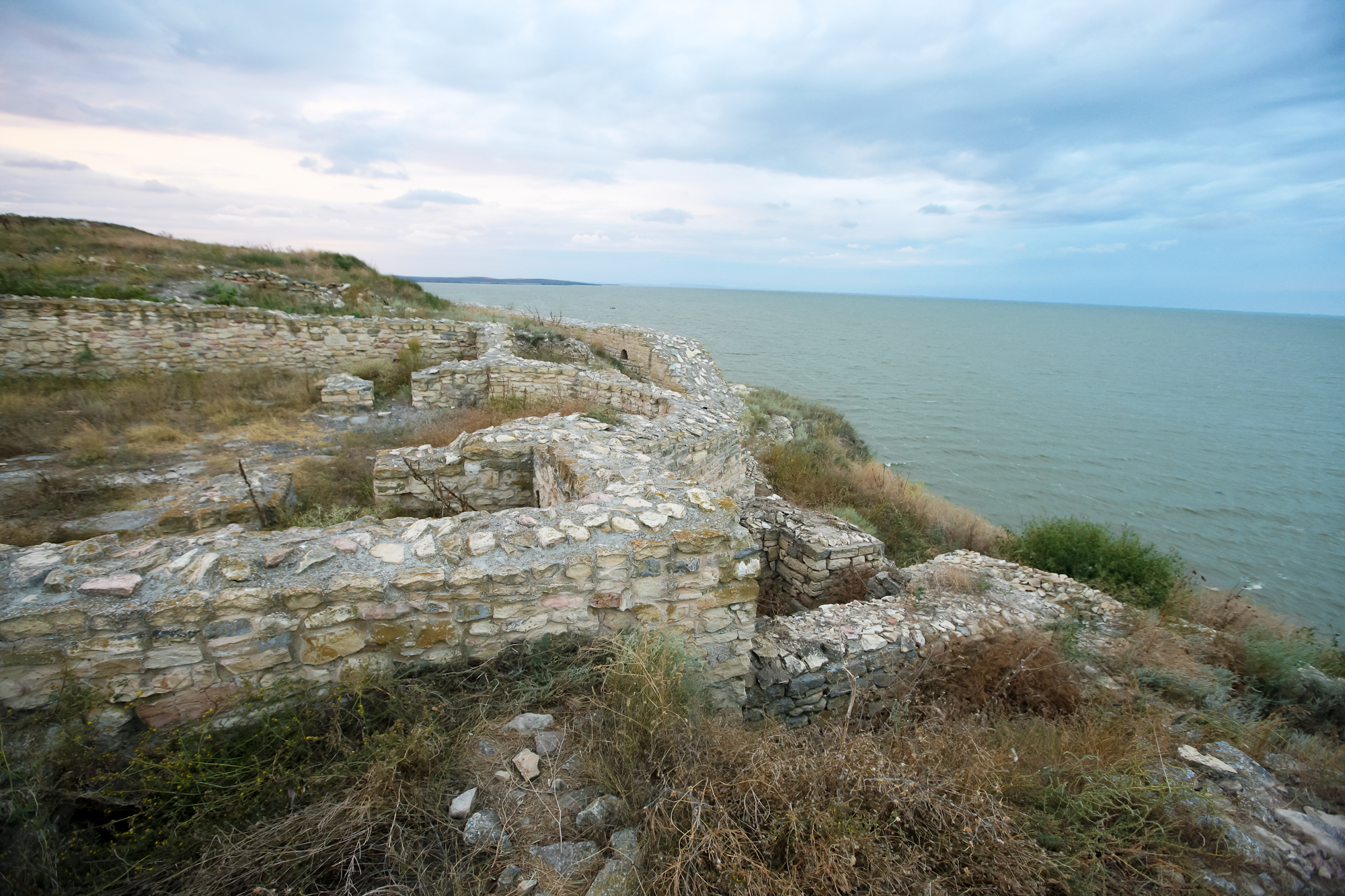
Photo: MHStudio · CC BY-SA 3.0
Razim, also written Razelm, is a large freshwater lagoon on the Black Sea coast of Romania, just south of the Danube Delta. It is the largest liman in Romania, and it is part of the delta's World Heritage Site. Fishing is the traditional livelihood of the region, and the lake is valued as a habitat for birds and invertebrates.
How it formed
Razim belongs to a complex of limans, or coastal lagoons, on the Black Sea. The northern group, with Razim and the neighbouring Golovița, holds fresh water, and the southern lagoons are salty.
History
The lagoons were separated from the sea in the late 1970s, with large changes in conditions: the water became almost entirely fresh, it stayed longer in the lake, and algal blooms appeared. Fishing has been the main livelihood of the delta’s people since ancient times, although today the fish catch is smaller and of a different quality.
Fishermen and fortresses
Jurilovca is a fishing village founded in the 18th century by Lipovan fishermen, with a view over the lake from Cape Dolosman, where the ruins of the ancient fortress of Argamum lie. Enisala fortress, on a limestone hill above Razim and Lake Babadag, is a medieval stronghold from the 13th or 14th century, probably built by Genoese merchants, and said to be the only surviving medieval fortress in Dobrogea.
Nature
Despite the environmental damage, the lake remains an important habitat. Of the families of cockles that lived here in the 1960s, the two that remain are found only in Razim, and at lower numbers. Popina Island at the northern end of the lake is a refuge for many birds and invertebrates. A recent ecological study suggests that the lagoon system is close to the good ecological status the European Water Framework Directive requires.
Birds
Look for white and Dalmatian pelicans, egrets, herons and swans, with early morning and sunset the best times. Cape Dolosman is a favourite place for birdwatchers, especially in November when large numbers of red-breasted geese arrive. May and June are recommended for birds and flowers, and autumn for colour.
Visit
Swimming
No reliable information
Tips
The wider lagoon system belongs to the Danube Delta Biosphere Reserve, where fishing, hunting, animal husbandry, subsistence farming, reed harvesting and tourism are the main activities. Access and rules depend on the reserve, so check them before you go. The climate is temperate-continental with a Black Sea influence.
A day around the lake
Jurilovca is a good base. It is about 55 km (an hour) from Tulcea by road, with buses and minibuses. From the harbour boats run to Gura Portiței, a sandy island with shallow water. A full-day loop can combine Jurilovca, Enisala and Histria; note that Histria, an ancient Greek city, is on Lake Sinoe, not on Razim. Allow at least two hours for the walk at Dolosman.
Nearby lakes
Show on map


Know Lake Razim well?
Suggest a beach, viewpoint, trail or amenity, or tell us if something has changed. We read every message.
Sources & data
- NGI (ARCH project): Razelm-Sinoe Black Sea lagoon in Danube Delta Biosphere Reserve, Norwegian Geotechnical Institute (NGI)
- English Wikipedia: Lake Razelm (revision 1366268086), Wikimedia Foundation, 2026
- Dinu et al. (2015): Modelling of the response of the Razelm-Sinoe Lagoon System to physical forcing, Geo-Eco-Marina 21, 5–18 (GeoEcoMar), 2015
- Wikidata: Lake Razelm (Q2349738), Wikimedia Foundation
- Wikipedia: Lake Razelm, Wikimedia Foundation
- Jurilovca: multicultural heritage and ancient history, Uncover Romania
- Razim Lake: the authentic tranquility of the Danube Delta, New Lebada Resort